
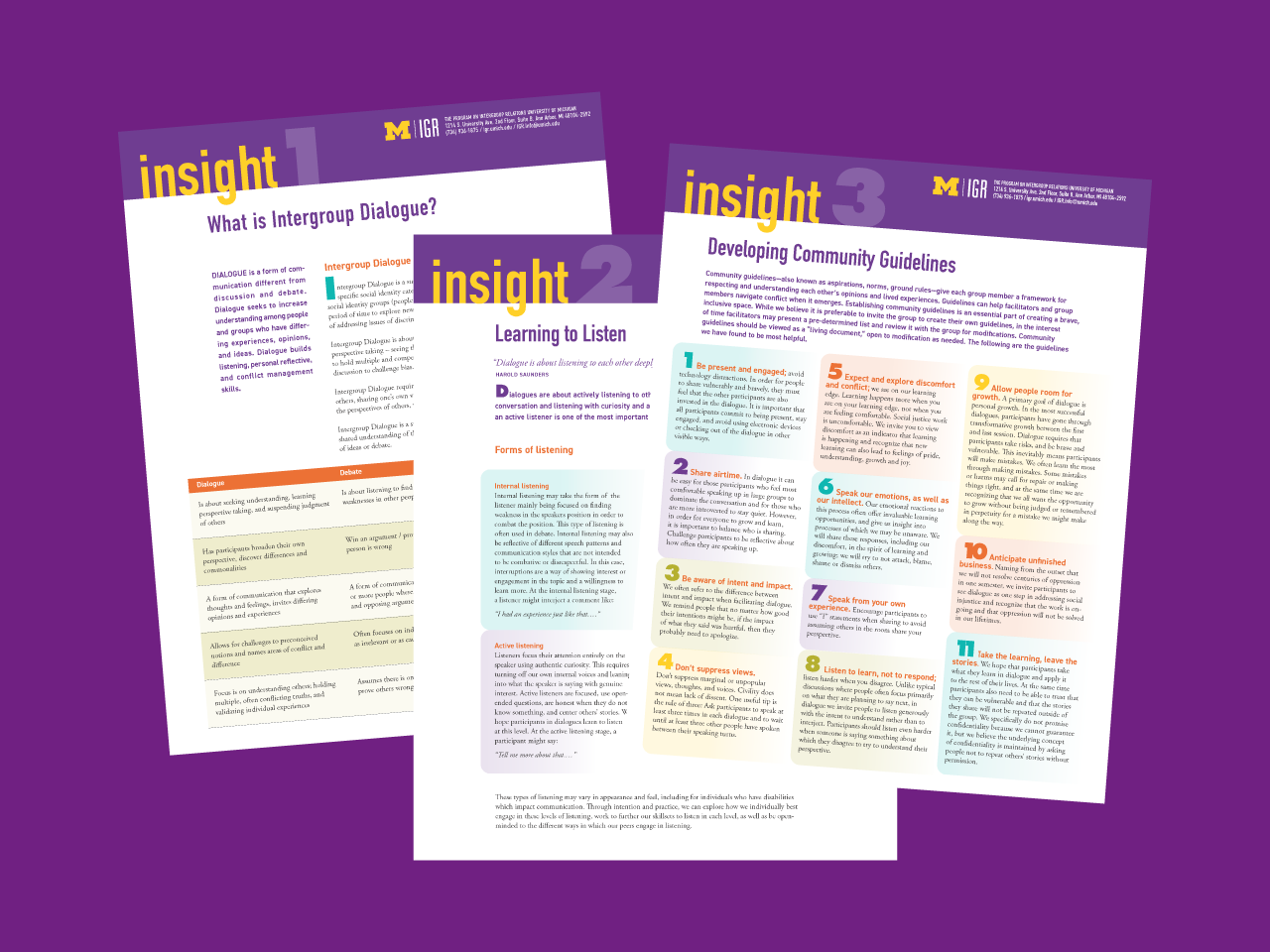
IGR Insight handouts offer 11 pages of invaluable resources for those applying dialogic techniques on campus and beyond.
Topics include strategies for managing hot moments in the classroom, learning to listen, interrupting bias, how to apologize, and many more useful tools.
Below, view and download handouts individually or as a single PDF.
1. What is Intergroup Dialogue?
Defining and comparing dialogue, intergroup dialogue, debate, and discussion.
2. Learning to Listen
Explaining four forms of listening—internal, generative, active, and global.
3. Developing Community Guidelines
A starter pack of guidelines to help group members enter difficult dialogues and respect one another.
4. The Four Levels of Oppression
Defining and demystifying individual, interpersonal, structural/systemic, and cultural oppressions.
5. Facilitator Personal Assessment Chart
Making an inventory of personal resources you bring to a social justice framework.
6. Master Narrative, Multipartiality, and the Counter Narrative
Demystifying key types of narrative.
7. Intergroup Dialogue Co-Facilitation
In dialogues, co-facilitation provides a more effective and democratic model of education.
8. Strategies for Managing Hot Moments in the Classroom
Tips and approaches for instructors of all teaching methodologies.
9. Microaggressions: A Primer
Definitions, examples, and impacts of microaggressions, and strategies to address them.
10. Interrupting Bias: PALS
PALS can be used as part of an intergroup dialogue or as a skill applied in your daily life.
11. How to Apologize: Re-Aact
Mistakes happen. What we do next doesn't have to feel scary. "Re-Aact" is here to help.