
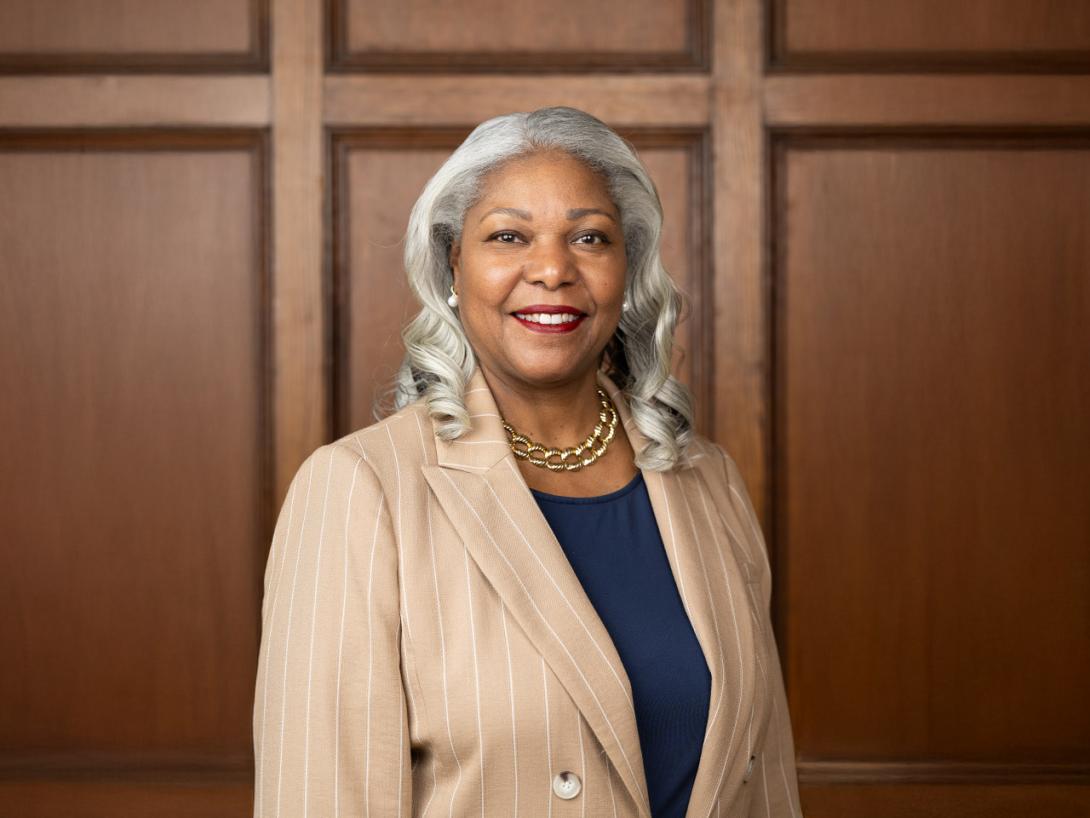
July 17, 2025 | By Nick Pfost
Monita Thompson on IGR, dialogue, and the future of social justice education
When Monita Thompson first came to the University of Michigan in 1992, she had never heard of The Program on Intergroup Relations and Conflict (IGRC), now known as The Program on Intergroup Relations (IGR). Like so many others, she was drawn to U-M by its world-class doctoral programs—as well as the opportunity to return to her hometown. Her plan was to become a student advisor or dean of students.
In one of life’s fateful coincidences, she found IGRC through a graduate course. As she recalls, “that was it.” She knew she had found where she was meant to be.
Over the nearly three decades that followed, Monita has been a guiding force at U-M, championing social justice education and building on the institution’s legacy as a national leader for intergroup dialogue. From program associate to associate director to co-director, her student-centered approach has been highly skilled, collaborative, and strategic. Those were qualities that made her the clear choice when Student Life (formerly Student Affairs) sought leadership for special projects, a shared role as assistant dean of students, and interim roles heading Multi-Ethnic Student Affairs, Trotter Multicultural Center, and a former iteration of the multicultural portfolio. Her stewardship, advocacy, and dedication to fostering understanding across difference have left an indelible mark here, around the country, and in the lives of generations of students.
After 28 years of service to U-M, Student Life, and IGR, Monita will retire on August 15, 2025. As we celebrate Monita’s legacy and lasting impact, we sat down with her for a final Q&A—reflecting on the evolution of IGR, why we need intergroup dialogue, and her thoughts for those carrying this work forward.
Q: What would you say to someone who’s unfamiliar with IGR about why this work is important?
Monita: We live in a society and a world where inequality exists and yet we don't often talk about it or the impact that it has on all of us—at least not in a meaningful way. But there are a lot of times when simply naming things that are going on would make a difference in creating understanding.
The first real touchpoint is helping people build skills for dialogue: deep listening, feedback, reflection, and agreements on guidelines. Then having people examine who they are, why they think the way they do, and where these notions came from, as well as why others have a different experience, and how social identity and societal norms may have played a role in their experiences.
IGR creates space for people to understand each other—not agree, but be curious and seek to understand others. Importantly, IGR has a unique focus on social justice. If the learning stops at understanding and interpersonal skill building, it fails to recognize the social inequality that exists in the world. Focusing only interpersonal skills would, in effect, continue the status quo and normalize institutional and structural oppression of marginalized populations and groups. IGR has fostered students to be change agents in the world, and it is a joy to see how our alumnx are making a difference in their chosen fields and communities.
As Pat Gurin once said, “What the one person can do is analyze, organize, persist, and encourage others.” That’s why this work is so important.
How has the landscape of intergroup relations changed since you started?
I think in the early days we had a lot of focus on Black, white, Jewish identity, and sexual orientation. After September 11, 2001, there was a lot of interest in dialogues between Arab, Muslim, and Jewish students. Around the time of Prop 2 (2006), we saw more interest in discussions of affirmative action in the intergroup dialogues around race, ethnicity, and social class and waves of interest in gender and sexuality surrounding civil rights efforts and marriage equality achievements. So issues of interest reflect the current societal events.
Language is another area that is ever-evolving, and we learn a lot about it from the students.
Additionally, the field has grown in higher education overall. Institutions have created programs on intergroup education for their campuses—many, in part, due to IGR alums and our direct work through our institute. I think the multi-university research project and the findings presented a compelling case for intergroup dialogue in higher education.
How do you think IGR has changed or evolved over your tenure?
We've created new programs and added many courses—the National Intergroup Dialogue Institute, the minor, CommonGround student workshop program, and our focus on the experience of students involved with IGR. Additionally, we have created a position to focus on building the campus community capacity for intergroup and social learning for faculty and staff.
What inspired the launch of the National Intergroup Dialogue Institute, and how did that come to life?
Our alums and colleagues were making their way in the world! People who were involved in IGR here at U-M had moved on to other institutions, shared their IGR experiences with others, and we were getting calls—"Can you come to my institution?"; "I was part of IGR and I've been telling my supervisor about it, and my dean is excited and wants to know more. Can you come and give a training?"; and “My workplace needs IGR. Can you help us?” This was happening both in higher ed and in the private sector.
Now, keep in mind that IGR had a very small staff. I think there were four people in '97, one of which was Charles Behling, who was halftime as co-director, Teresa Brett, full-time Student Life co-director, myself, and an admin assistant. So, with the interest, it just wasn’t possible to fulfill these requests while teaching and overseeing the program, but we saw the need and knew we had something to offer. At some point, we started asking ourselves, “Well, why don't we bring people here? We can set a time, they come here, they learn, and we cut our travel and time away from U-M.”
But we didn't have any money to actually put this on, either. So we went to Royster Harper, our vice president for student affairs at the time, who was a supporter of IGR and saw our work as really important. We said, "Hey, we've got this idea. People are calling us. We can't really do all this travel. We think we could bring people here and charge to attend, but we need some seed funding.” I think it was $10,000. She said ‘okay’ and gave us the funds to put on this first institute at the [Michigan] League. It wasn’t perfect, but we learned a lot, had robust discussion, people had a good experience, and we made the seed money back and then some. When we went to return the money to Royster, she told us to keep the money to continue the program.
During your time in leadership, IGR grew significantly. What strategies helped you navigate that?
We had a lot of help through the years. Professors Pat Gurin and Mark Chesler were very instrumental in providing guidance through our growth. As a Student Life program, IGR was strongly supported by then vice president Royster Harper. Years ago, three of us were around the table—Charles, Teresa, and myself—to do some visioning. “What would a Chronicle article look like if it was written about IGR in 20 years?” I remember saying I’d feel good if I had a legacy that IGR had a minor. At the time, it honestly felt like a pipe dream—we had three courses with Charles and Teresa teaching first year interest groups, and only recently had the three core courses permanently solidified in psychology: intergroup dialogue, facilitator training, and practicum.
But we kept coming back to it and, incrementally, we made progress. Before Ximena [Zúñiga] left and with the support of Pat, then the chair of psychology, she secured permanent course numbers in psychology for training, practicum, and dialogue. Over the next few years, we offered some first-year courses. And when Pat became an interim dean for LSA, she helped strengthen the LSA connection by having IGR undergo an internal/external review to make our case to be academically associated with LSA, moving IGR from the psychology department. It was then that IGR became a partnership program between Student Life and LSA. And when LSA began accepting more minor programs in the 2010s, we were ready—and it happened. 2015 was our first minor class.
How did IGR change you?
IGR changed me both personally and professionally. Personally, because it helped me to examine my own identities and circumstances. I had to acknowledge that, while I had focused on the several marginalized social identities I have, I also hold more identities that are privileged in society. As a middle-class, Black, Christian, heterosexual woman with no disabilities, I'm also a part of the social oppression of others and I couldn’t absolve myself of this fact. I realized that inequality and oppression were linked to a larger societal problem. As I learned, I vowed to help others learn.
Is there any advice you'd offer to those carrying on the work?
To everyone—Don't lose sight of the mission. As IGR grows and expands, remember that students are at the center of the work. We educate students about intergroup relations and social justice education with a focus on their overall development so they will become change agents who can make the world a better place.
To our alums and current students—Oh, I'm so proud of you all! Continue to make “good trouble.”
For some of you, it may feel like this is a world right now that you’ve never seen before. It can feel oppressive and leave you unsure about the future. But I also think about what MLK said: "The arc of a moral universe is long, but it bends toward justice." Know and believe that you have many more years ahead than the people who are making some of the decisions right now. And you’ll have the longevity to bend that arc. Even as we grapple with what’s happening today, don't give up. You have to play the long game.
What’re your plans for retirement?
To do whatever I want, whenever I want!
Read more