
April 1, 2026 | Graduate profiles
Each of our graduating students has a different story, but they share a common thread: learning through dialogue and community. In this Q&A series, graduating students from IGR reflect on moments that challenged them, people who shaped them, and skills they’ll carry forward after graduation.
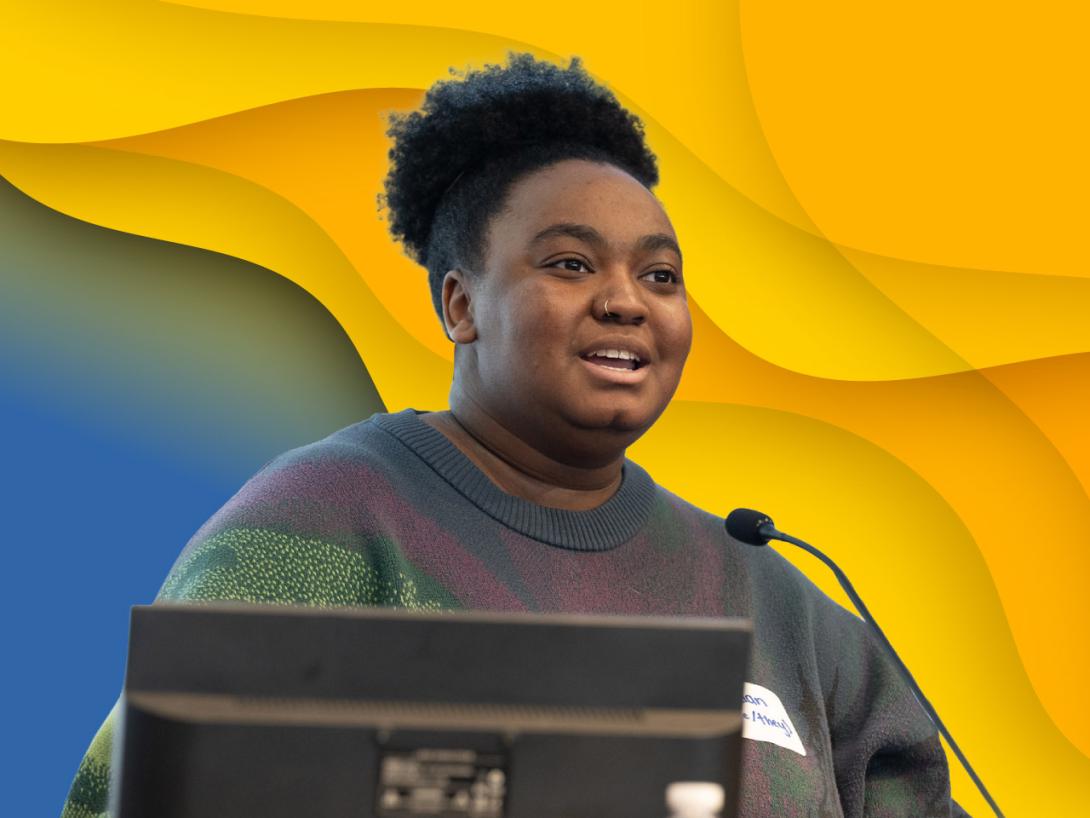
This April, Jordan Hunter (BA '24, MURP '26) will be recognized as an IGR graduate for the second time when they receive the Patricia Gurin Certificate of Merit in Intergroup Relations and the liberatory education cord. In this short interview, Jordan looks back on their IGR experiences and the ways CommonGround and dialogue influenced her learning, leadership, and sense of community.
Q: How did the IGR community shape your experience at university?
Jordan Hunter: Well, I think if I'm being totally honest, I wouldn't even be at this university if it wasn't for IGR.
When I was 16, just after my sophomore year in high school, I did Summer Youth Dialogues and that was kind of where I first got introduced to the work that IGR does. And I loved that program. I really loved getting the opportunity to meet people who were so different from me. And I told myself that's the experience I want for the rest of my life. I want to be somewhere where I can meet people from totally different walks of life. I applied to Michigan and honestly every decision that I have made has involved IGR in some way.
My first job was actually being a CommonGround workshop facilitator. And part of the reason why I joined CommonGround was because my roommate from my experience in Summer Youth Dialogues was in CommonGround. One of the grad interns at the time was Meaghan Wheat, and she had been one of the facilitators for Summer Youth Dialogues. I was just so excited about getting to experience that, so I joined CommonGround as a freshman. I'm now in my second and final year of grad school, so it's been about six years.
And I think there's a lot to be said about why I stayed in IGR and what made me continue doing the work even when it got hard, and all of these things happening around the university, the cancellation of DEI and those things. IGR feels like family to me. Overall, this is a very predominantly white institution and there are spaces where I don't feel like I can be my full self as a person of color, as a woman of color, and specifically as a black woman.
But I feel like IGR has always allowed me to be my full self, whatever form that's taken. No one should be the same person they were when they were 18, but IGR has always made room for the person that I became, even when I was really going through it and was kind of a hot mess. There was always space for me at IGR. There was always someone who was willing to hear me out, willing to listen to what I had to say when I felt like no one else on campus wanted to hear that.
Can you take us back to a moment, reading, or discussion that you feel challenged or expanded your understanding of dialogue or intergroup relations education?
One that really sticks with me and probably the one that I can remember the most was my second time facilitating Summer Youth Dialogues in 2024. I had just graduated from undergrad.
And I think something I had always appreciated about IGR up until that point was just how much I was able to take in, but it was facilitating SYD that year that made me think less about what I could receive and more about what I could give to the people coming behind me. And I feel like stepping out or stepping into a new part of my social justice journey, or it was starting to be about reaching back and thinking about where I was when I was earlier in my social justice journey and thinking about moving other people along and that kind of work. I think that honestly has had such a huge impact on how I approach being a grad intern now.
I'm thinking a lot about leadership. How do I make sure that the undergrads that I'm coaching and supervising can be leaders when I'm gone? Because I know I'm not going to be here forever. The work continues and I want to do whatever I can to make sure that people can continue doing that work. Sometimes in social justice spaces, I think there can be this narcissistic tendency of thinking that you alone are going to solve problems and change the world.
That’s good to be thinking about [your role in change], but I think that sometimes some people don't realize it's not going to be only you. This work is so complicated that one person cannot change all of these systems that we're fighting against. It's so important that you set up the people who come behind you to continue the work and continue the fight and go further than you ever could.
What practical skills from IGR do you feel best equipped to bring into your work as a student, professional, or leader?
IGR was the main resource I got out of U-M. I grew up in Ann Arbor, so I'm very familiar with campus. I knew how to access the things that I needed for the most part, but there's nowhere else on campus like IGR. There's nowhere else where people are able to have such honest and open conversations.
How did IGR shape your career interests?
I think that the biggest thing that I'm really thankful for with IGR in terms of my Master of Urban and Regional Planning program is that knowing how to facilitate frankly makes me an urban planner who is not afraid of actually doing real community engagement work.
I am not afraid of conflict. If I'm leading a community engagement meeting and somebody tells me that something I did in their community pissed them off, I'm not going to shut down. I'm going to approach it with curiosity and say, “Okay, what about this in particular makes you upset? What is it? Is it how it was done? Is it just the thing itself?”
We've done multiple projects where we work with a client in a community, and every single time I become the community engagement person. It’s because IGR gave me the skillset to facilitate those hard conversations. Urban planning was something that I was interested in separately from IGR, but IGR informs the way that I approach urban planning.
I learned about how important it is to be in contact with other people, which is such an underrated part of urban planning. I think other people in my program tend to see themselves more as architects and engineers, but that's not what our profession is. Our profession is a form of macro social work, and if you're not willing to see it as such, you're not going to be an effective urban planner.
How do you hope to take your IGR experience out into your future?
I think a lot of those facilitation skills I learned have really impacted why I want to do more community engagement-style work. I do at some point in the future want to do a PhD in some sort of cultural policy, arts, and community engagement work. And I think for me, it's so obvious that IGR and the things that I learned in IGR really impact why I want to get that PhD. I think that knowledge-sharing is so important, and one of the things I've always appreciated about IGR is that nothing's ever locked up. No one is ever like, “We're not going to tell you this thing until we feel like you're ready.” If you have questions, someone always has an answer.
I think that a huge part of my professional journey was my work in CommonGround and getting to experience what it means to supervise and coach someone before I even graduated with a master's degree. And now I'm able to think about what supervision looks like when it's not punitive, when supervision is particularly focused on someone's growth and learning and how much better that relationship is for everyone involved. When I leave grad school, I'll be able to really advocate for myself and say what I want that professional supervision relationship to look like because I've had a really incredible supervision relationship. I've been a very good supervisor, and so I think that will just be able to inform how I go about my work in the future.
How do you think IGR shaped your growth?
I think the biggest thing is just approaching things with curiosity and approaching things openly. Especially in the political climate that we're in, I think that it's so easy to close yourself off and to just not really accept things that are different from what's already in your head.
IGR has taught me to absolutely not do that. Even when it's hard, even when being in community with people who are not like you is hard, it's worth it. And I think that the openness that I've learned in IGR, and that people have shown me while I've been in IGR, is probably one of the biggest things I want to take into my life.
Read more