
August 5, 2025 | By Nick Pfost
Building inclusive, resilient campus communities has never been more urgent—or more complex.
As higher education institutions face mounting demands to bridge social divides, respond to shifting norms and policy, and equip students for a rapidly changing society, there is growing recognition that reactive fixes alone won’t dismantle longstanding barriers. The work requires sustained human effort, deep institutional commitment, and real resources—factors too often in dwindling supply.
Yet, in the midst of these challenges, colleges and universities nationwide are turning toward intergroup dialogue as a transformative approach.
Drawing on research, practical experience, and an ethos of empathy and humanity, intergroup dialogue empowers students to engage across differences and nurtures a sense of belonging.
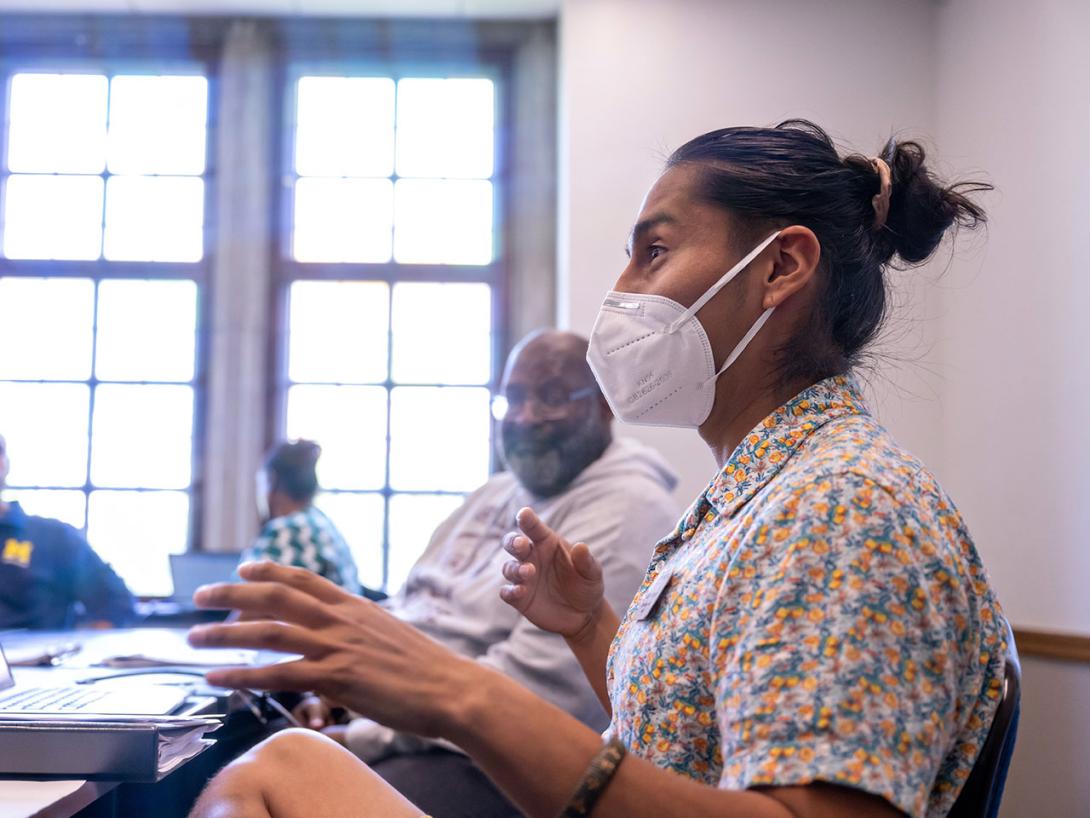
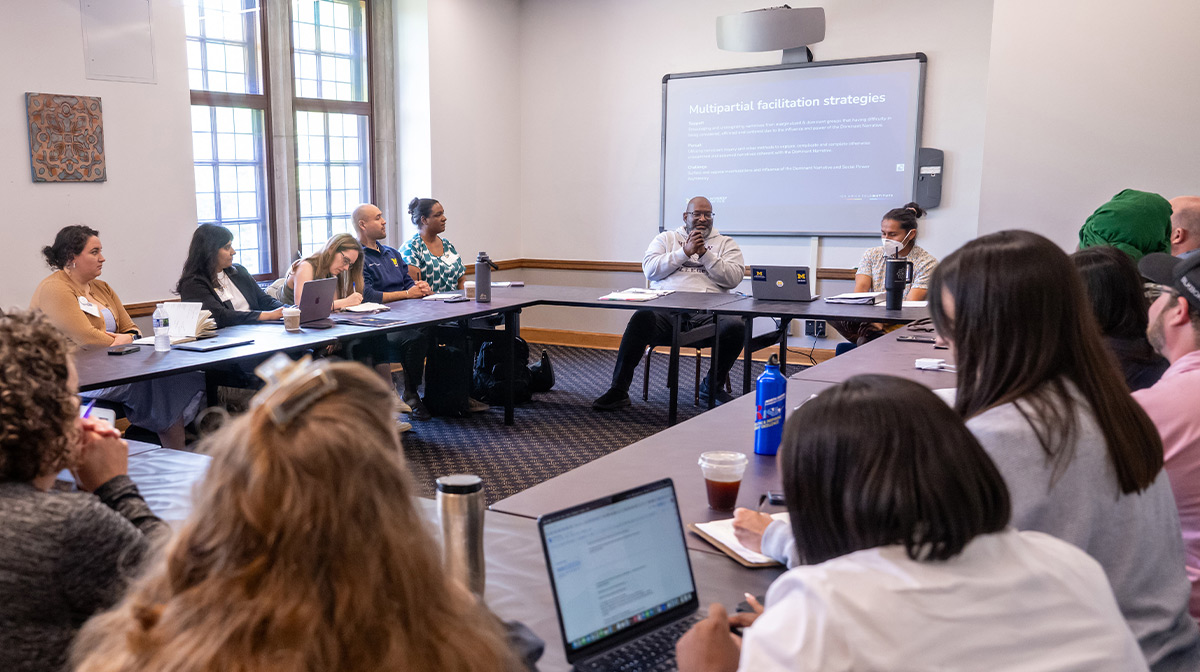
This summer, 60 faculty and leaders from across the country gathered in Ann Arbor for the National Intergroup Dialogue Institute to learn how to create or grow intergroup dialogue programs at their own institutions.
The Program on Intergroup Relations (IGR)—a partnership of U-M’s College of Literature, Science, and the Arts and the Division of Student Life—led sessions throughout the four-day program. The goals were to:
- explore the Michigan Model of Intergroup Dialogue
- share strategies for using dialogic pedagogy in curricular and co-curricular programs, and
- equip participants with a foundation of institutional strategies for developing and building support for dialogue programs that suit their institutional context.
And while barriers remain—limited staffing, stretched budgets, and shifting political climates common among them—there was renewed hope among attendees that intergroup dialogue can foster lasting change and a more inclusive future for higher education.
What is the Michigan model?
The Michigan Model of Intergroup Dialogue is a structured, four-stage process focused on exploring social identity, gathering members from different social groups to regularly meet and address discrimination and social inequity.
It involves listening to different viewpoints, gaining insights, and seeing through others' eyes, all while challenging biases and considering multiple perspectives.
With the support of trained peer-facilitators, participants learn to listen generously, ask questions, share their views, and commit to understanding others, seeking shared understanding rather than casual exchange or debate.
The approach has been nationally recognized for its impact on the learning outcomes of students across all groups.
Inspired, equipped, and energized
Attendees came away energized by the support and community, and felt prepared with valuable insights and tools for building intergroup dialogue on their campuses.
“The [institute] gave my team a lot of tangible material and resources to build our program,” said Nyk Robertson, a senior diversity officer at Emporia State University. “The IGR staff and faculty are approachable, passionate, and willing to assist.”
“The National Intergroup Dialogue Institute was an incredibly valuable experience,” added Nancy Maingi Ngwu, a strategic dialogues director at the University of Colorado-Boulder. “It deepened my capacity to continue to vision, co-lead, and implement dialogue work on our campus, broadened my sense of what’s possible within our broader community context, and connected me to a network of amazing scholar-practitioners dedicated to this important work all over the country. I left feeling inspired, better equipped, and energized to advance this work in meaningful ways.”
“The tools and insights I gained will directly inform our institutional strategies and help us cultivate a more inclusive and responsive campus community,” said Adam Klepetar, the vice president for student affairs and enrollment management at Berkshire Community College.
Melanie White, who works with first-generation students at the University of Tampa, called their experience “powerful” and “transformative.”
A beacon of hope
As higher education continues to navigate turbulent times, the momentum from this summer’s institute offers hope. Leaders are returning to their campuses inspired and equipped, determined to nurture spaces where every voice is heard—proving that, even in the most complex climates, authentic intergroup dialogue can foster the change our communities need.
“Preparing our students through listening, inquiry, and a deep commitment to understanding is invaluable,” says Patrick Kazyak Albaladejo-Muñiz, an associate director at IGR.
“As a national leader in social justice education and intergroup relations, especially during this moment of global democratic backsliding and increased social divisions, it feels more important than ever for our program to support our colleagues across the country and globe as they continue to implement innovative and transformative dialogue work on their campuses.”
Hosted at the historic Michigan Union, this year’s was the first institute held in-person since 2019. The Program on Intergroup Relations will welcome a new cohort for the 20th annual gathering in Ann Arbor, June 15-18, 2026.
Read more